
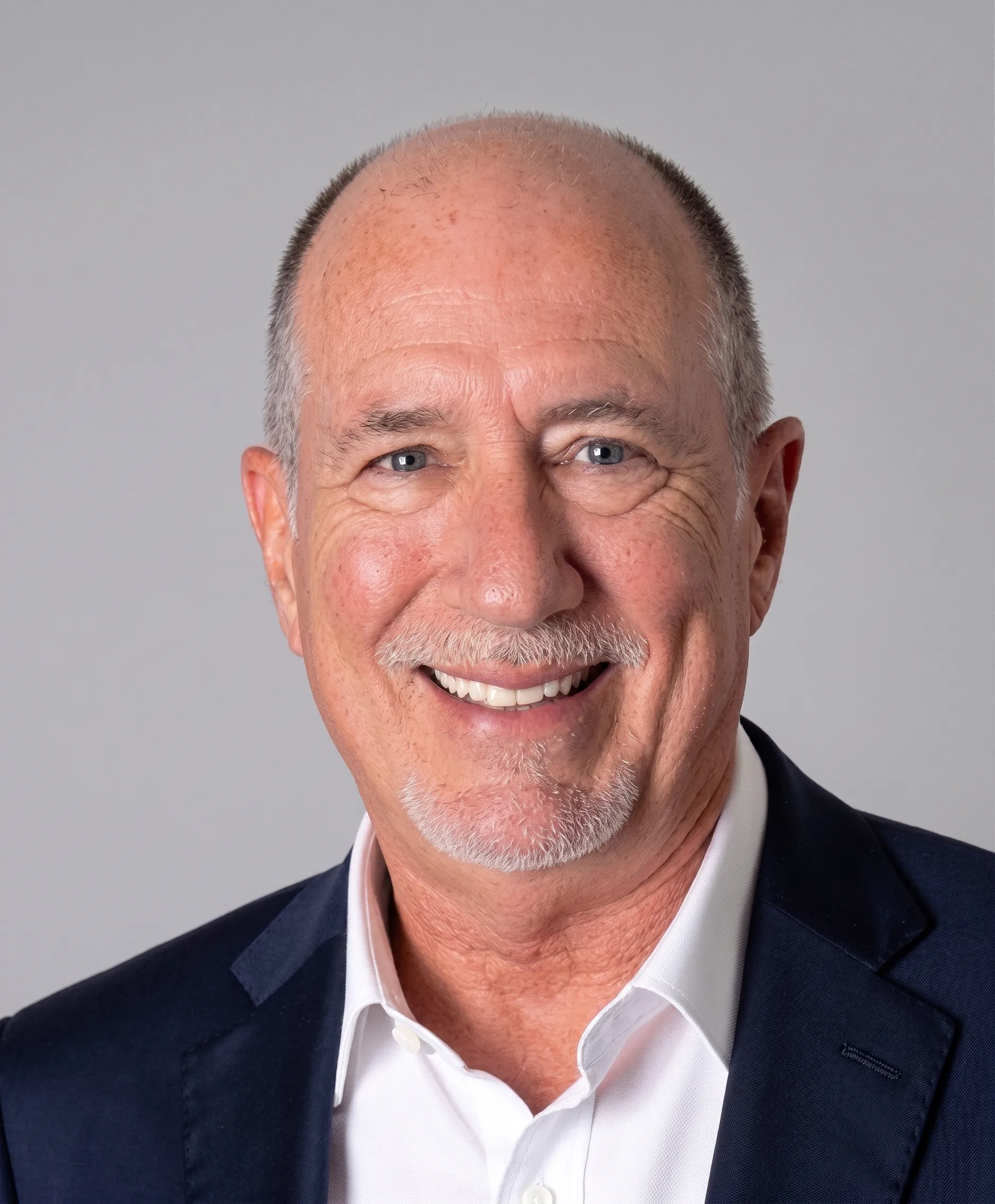
Keynote Speaker, Sales Coach and Private Counsel

Your buyer arrives fully briefed. The deal still turns on what they feel.

Keynotes, sales team work and private counsel from four decades on the human side of the sale — the half no machine can do for you.

Or read the one idea everything here is built on
700+
presentations delivered
500+
to Vistage CEO groups
6,000+
CEOs coached
1M+
learners on LinkedIn Learning
1
company built and sold

Hidden conversations

The deal is decided in a conversation you are not in.

You built the deck, ran the demo, sent the follow-up on time. None of that is where the decision got made. It got made in three conversations nobody invited you to.

You cannot script those conversations, and you cannot automate your way into them. You can only change what people carry into them — which is a story about you, about the risk, and about who they become if they say yes.

The same pattern runs everywhere else in the building. The exec who cannot delegate. The manager everyone tiptoes around. The partnership that curdled over something nobody said out loud. Different symptoms, one cause.

  • One

    In your buyer's head

    The story they are already running about your price, your category, and what saying yes says about their judgement.

  • Two

    In the room after you leave

    Your champion repeating your pitch, badly, to four people who never met you and are not inclined to be impressed.

  • Three

    In your rep's head

    The salesperson who decided how this call was going to go somewhere on the drive over, and then went and proved it.

People are not running your sales process. They are running a story.

And the story got written long before your first call, by somebody who was not thinking about you at all.

The edge

AI can explain your product. It cannot make anyone trust you.

Your buyer arrives researched, briefed, and holding a comparison you did not give them. Every rational objection has been pre-answered by something that never gets tired, never gets defensive, and never needs the commission.

The information advantage is gone. It is not coming back, and no amount of product training returns it. If your sales process was built on knowing more than the buyer, it was built on ground that has already moved.

What is left is the part that was quietly doing the work the whole time: whether they believe you, whether they trust the room you put them in, and whether they like the version of themselves they become when they say yes.

That is not a threat to selling. It is a promotion.

The machine has this

  • Answers the specification question better than your best rep
  • Compares you against three competitors at two in the morning
  • Drafts the follow-up, the proposal and the summary
  • Arrives at the meeting already briefed on your pricing

This is still you

  • Reading the hesitation nobody said out loud
  • Earning the second meeting nobody had scheduled
  • Making it safe to admit the real objection
  • Changing what your champion says when you are not in the room

The core idea

There is one set of facts. There are a dozen stories about it.

I spent seventeen years as a trial lawyer. Every case had exactly one reality and about nine competing accounts of it, all sincerely held. That observation ended my litigation career and started this one.

We collect stories the way we collect scar tissue — quietly, without consent, and mostly about ourselves. The right story is one that works with reality, and life gets noticeably easier. The wrong story means you spend your days fighting reality and calling it leadership.

The negative hero

Good intentions, bad outcomes, and a persistent feeling that everyone else is the problem.

The most expensive story in business is the one that says I need to control this. It shrinks the opportunity and it makes people back away from you — buyers included — which produces exactly the chaos that convinced you to grip harder in the first place.

The good news is the same as it has always been. A story is not a fact. You can put it down and pick up a better one. I did — I went from divorced, burnt out and broke to a life I would choose again — and I have since done this work with more than 6,000 CEOs and their teams.

Victims, Villains and Heroes makes so much sense. Drama in the workplace is greatly diminished.
Bobbi DePorterPresident, Learning Forum
17 yearslitigating employment cases before deciding most of it was avoidable

The Emotional Edge

Five things that decide the room.

The signature program, and the spine of everything else on this page. Whether it runs as a keynote, a team session or a year of private counsel, the work comes back to these five.

  1. Emotional energy

    Every room has a current running through it. Somebody is setting it, and if it is not you, it is the most anxious person present.

  2. The three roles

    Victim, villain, hero. Everybody defaults to one under pressure. Knowing yours is worth more than another closing technique.

  3. Hidden conversations

    The dialogue running underneath the meeting. Surface it and the objection you have been guessing at finally says itself out loud.

  4. The negative hero

    Good intentions, bad outcomes, and a persistent feeling that everyone else is the problem. The most expensive posture in business, and the hardest to see from inside it.

  5. The setting

    The room, the seating, the ritual, the first ninety seconds. Conditions decide how honest people are willing to be, and most people never touch them.

Three ways to work together

Three doors. Same work behind all of them.

Most people arrive through one and end up using two. Start wherever the pain is loudest.

01 / Speak

For meeting planners, sales kick-offs and CEO groups

Keynotes that make the meeting, not fill a slot.

More than 700 presentations, over 500 of them to rooms full of Vistage CEOs who have heard every speaker on the circuit and are visibly braced for the next one. That audience does not applaud politely. It is the best training a speaker can get. No canned deck — I research your audience before I write, because the fastest way to lose a room of operators is to tell them something they solved in 2019.

Check my availability

What the room actually gets

  • Stories, psychology, and forty years of being in the room when it went wrong
  • A framework they can use on Monday, not a philosophy they admire on Friday
  • Take-home tools, worksheets and calculators — I over-deliver on this deliberately
  • Optional webinars before or after, so the learning survives contact with the calendar
  • The red nose. You will understand when you see it.

What I get asked for most

Signature keynote

The Emotional Edge

The five pillars, the three roles we all play under pressure, and why the human half of the sale got more valuable the moment the information half got automated. Consistently top-rated, and never delivered the same way twice.

Breakout

Mastering the Emotional Energy of Partnerships

Usually the breakout to the keynote above. What happens after the deal is signed and the relationship has to survive it — partners, channel, joint ventures, and the resentment that never makes it into the CRM.

Executive session

Sales Commission Agreements That Keep You Out of Court

Seventeen years of litigating employment cases, pointed at the document your sales organisation fights about most. What to put in writing before your top rep leaves with the account, and what happens to the plans that were never written down. Not legal advice — a checklist and the scar tissue behind it.
02 / Private counsel

For leaders who do not join groups

The Executive Confidant.

A coach in your back pocket. Somebody who will check your head, challenge the assumption you did not notice you were making, and keep your confidences permanently. I take four clients at a time, by mutual selection. That is the whole practice. It is not scarcity marketing, it is capacity — this work does not scale and I have stopped pretending otherwise.

Book the no-cost conversation

Who this tends to be

  • The sales leader who is good, and knows there is another level
  • The leader with the IQ handled and the EQ costing them the room
  • The founder who has outgrown their own operating manual
  • The executive circling retirement who suspects golf is not the whole answer
  • The high performer who created a problem, and a board that thinks the potential is worth the investment
  • The manager who is stressed, stuck and no fun at work or at home, where the cracks are starting to show in both

How it runs

  1. A no-cost conversationI learn what you are carrying, and I coach you on whatever is loudest that day. You will get value out of that hour whether or not we continue.

  2. A year, or nothingWe set a cadence and a budget for twelve months. Not because the calendar is magic, but because how you carry pressure, how you sell and who you are at home do not move in a quarter.

  3. Clarity, precisely namedLess stress, more money, the promotion, the exit, the health, the marriage — name it precisely, because vague goals are how people stay comfortable.

  4. One commitment per sessionEvery session opens with me asking whether you kept it. I am a no-excuse guy, and I will end a relationship that is not producing action. You are paying me for results, not company.

Family businesses: when the company is the family, the work rarely stays inside the org chart. That extends to the whole family through Veritage.

03 / Teams

For sales teams and the leaders running them

Your process is fine. Your people are running a story.

In-house work with the team that has to hold the conversations. A half day, a full day, or a sequence with webinars either side so nothing evaporates on the drive home. We work on the deals in front of you, not a case study about somebody else.

Talk about your team

The uncomfortable diagnosis: your pipeline problem is usually a trust problem wearing a process costume. Nobody says that in the QBR. Everybody says it in the parking lot.

What we build

  • A shared language for what actually happened in the deal review
  • Managers who can hold the conversation instead of forwarding the memo
  • Reps who can name the hesitation in the room instead of discounting past it
  • Honest answers to the questions your people are asking each other and not you

The manuscript

Half the emotional intelligence shelf is missing half the problem.

Those books teach you to think your way through emotion. But if you or somebody else is deep in nonsense, no amount of intelligence resolves it — because intelligence is not what built it.

The Emotional Edge is about the other half. Feeling your way through, and feeling good about yourself on the far side. It is the program I have been putting in front of rooms for years, and it is currently becoming a book.

You do not have to self-sacrifice, exhaust yourself, or live out of balance to be the hero of this.

This is your book if

  • Deals stall even when every piece of logic says they should close
  • You engage in self-limiting nonsense — and you do
  • You have fantasised about a workday with nobody in it
  • You are exhausted from controlling everything and everyone
  • You want the people around you to step up
  • You are stuck in a career, or a relationship, and something has to move
  • You know exactly what to do and you are still not doing it
Forthcoming

The Emotional Edge

The manuscript is in progress. The program is not — it has been in rooms for years, and it is what I am most often booked to deliver.

I have been a voracious reader most of my life. Not much surprises me anymore. This one was an exception. Buy it. Read it. And we’ll meet you on the 40-yard lines.
David DibbleThe New Agreements For Leaders
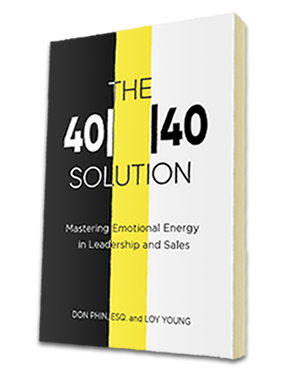
The 40||40 Solution book by Don Phin on mastering emotional energy in leadership and sales
The earlier book

The 40||40 Solution: Mastering the Emotional Energy of Leadership and Sales

Written with Loy Young, and still the fastest way to see where this work came from. The 40||40 exercise is the piece CEO groups keep asking about years later.

Get it on AmazonEvery keynote attendee gets a copy included.

Credibility

Forty-plus years of receipts.

700+
presentations delivered
500+
of them to Vistage CEO groups
6,000+
CEOs and executives worked with
3,500+
companies served by HRThatWorks — built from nothing, sold to ThinkHR
1M+
professionals reached through 15+ LinkedIn Learning courses
27
consecutive years editing the EPLiC Journal for IRMI
1983
admitted as a California employment practices attorney
40+
years on the human side of business

Seventeen of those years were spent litigating employment cases. I stopped when it became clear how much of it was avoidable, and how little of the avoiding was legal work. Since then: investigator, consultant, entrepreneur, sales executive, coach. I built HRThatWorks to 3,500 member companies and sold it to ThinkHR. Member of the National Speakers Association, certified virtual presenter, and a book-a-week reader for more than thirty years.

Rooms I have worked

What people say

The reviews that matter come from repeat bookings.

My CEO members loved his message and philosophy, and were greatly impacted by his 40||40 exercise.
Larry HawksMaster Chair, Vistage International
A rare blend of warmth and grit. He draws out the best in people.
Andrew DavisSenior Director of Product Marketing, Copado
He’s been wowing our members in person and via webinar for 17 years. It’s not just for salespeople. It’s for life.
Preston DiamondManaging Director, Institute of WorkComp Professionals
Intuitive, insightful, creative and direct.
Mark Heyman, PhDDirector, Center for Diabetes and Mental Health
A no-nonsense, well-respected, knowledgeable, practical professional with a heart of gold.
Alan SorkinVistage Chair

Free tools

Take the tools whether or not you ever hire me.

I have spent decades building the checklists, calculators and worksheets I wished existed. They are free, they are not gated behind a demo, and several hundred HR leaders use them every week.

  • Turnover Cost CalculatorWhat a departure actually costs you, in your numbers
  • Engagement Retention ToolWhere your retention budget is going to waste
  • Stay Interview QuestionsThe conversation to have before the exit interview
  • The Entrance InterviewDay-one questions most companies never ask
  • 4 Phases of Emotional DevelopmentVictim to hero, with a heart
  • AI Ethics and Compliance Policy for HRA starting draft you can adapt

FAQ

Straight answers.

Anything not covered here gets answered on the call, in plain numbers, the first time you ask.

Talk to Don
What does a keynote cost?

It depends on format, travel and how much wraparound content you want. Tell me the date and the room and I will give you a number on the call, not after three rounds of email.

How long is a typical keynote?

Anything from a 60-minute keynote to a full-day hands-on workshop. At most events I deliver the keynote and a breakout session.

Do you speak virtually?

Yes, and I am a certified virtual presenter. That certification exists because virtual is a different craft, not a smaller version of the same one.

How many private counsel clients do you take?

Four, by mutual selection. That is the whole practice. If I am full or if I think somebody else is a better fit, I will tell you on the first call and point you at them.

Is the first conversation really free?

Yes, and it is a real session, not a sales call with a discovery script. You should leave it with something useful even if we never speak again.

What is the minimum commitment for private counsel?

A year. Not because the calendar is magic, but because the things you actually want to change — how you carry pressure, how you sell, who you are at home — do not move in a quarter.

Are you still practising law?

No. I have been a California employment practices attorney since 1983 and I litigated for seventeen years, but I coach and speak now. Nothing here is legal advice.

What is the red nose?

Come to the keynote.

Don Phin, keynote speaker and executive coach, Juno Beach, Florida

One conversation is usually enough to know.

Whether you are booking a keynote, looking for a confidant in your corner, or trying to work out why good deals keep stalling — start with a call. I will tell you quickly if I can help. And I will point you somewhere better if I cannot.

Talk to Don

don@donphin.com(619) 852-4580